Christie's blinks. The AI auction that almost was, and what its absence tells us.
The pulled lot wasn't a victory for traditional artists. It was a question Christie's wasn't ready to answer in public.
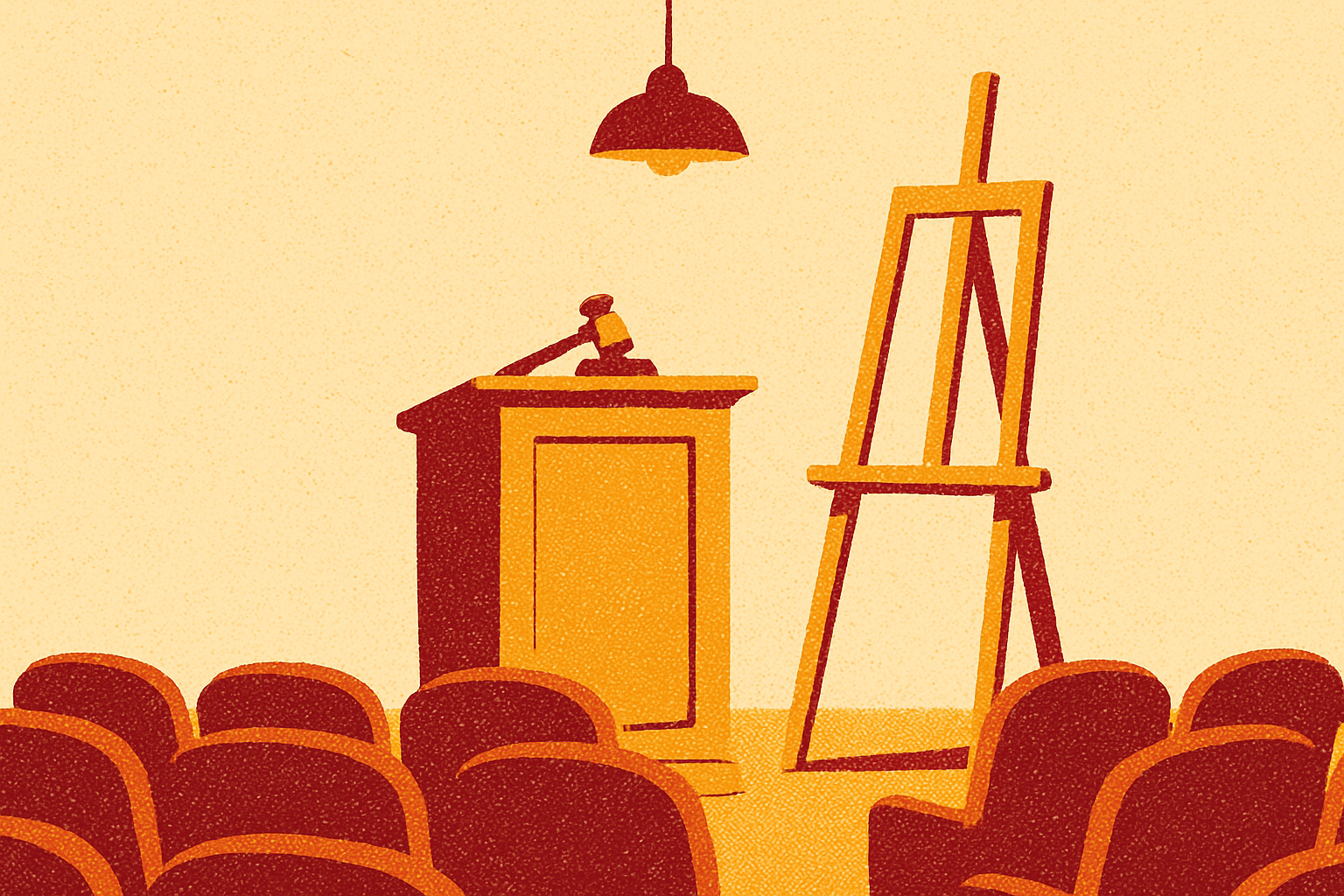
When Christie's quietly removed the lot last Thursday — a generative work the consigning gallerist had insisted was indistinguishable from a Klimt study — the auction house cited "provenance review." That phrase is doing a lot of work.
There is no provenance to review. The piece was made in eleven seconds. What Christie's was really reviewing is whether the institution of fine-art auctioneering can hold a hammer over something that has no past.
Daniel Cassady, writing for ARTnews this week, frames it as a withdrawal under pressure. He's right, but only halfway. The pressure didn't come from purists or even from the artist class. It came from the buyers themselves — collectors who, after the initial novelty, started asking the only question that matters in this market: what am I actually buying.
The honest answer is: a file, a story, and the auction house's seal of approval. Two of those three are infinitely reproducible. The third is the entire business.
It's tempting to read this as victory for the painters. It isn't. The painters are no closer to selling. What's happened is that Christie's has glimpsed, briefly, the shape of a market it can't authenticate, and stepped back from the edge.
Refik Anadol — whose machine-learning installations are pulling crowds at MoMA the size of any blockbuster the museum has hosted in a decade — operates in a different register entirely. His work is experiential, site-specific, and deliberately resistant to the auction model. The crowds don't queue to own. They queue to be inside.
Maybe that's the actual edge. Not whether AI art is real art. Whether the market we built for art still maps onto what people now show up for.
The middle ground here is uncomfortable for both camps. AI work is making real art, and real artists are not being replaced — but the institutions that profited from scarcity are about to discover scarcity is a story, and every story can be retold.