No phones, please. What art fairs were quietly selling, and why they want it back.
The grey bowl on the gallery desk is a small object doing a large amount of economic work. Friction has become the new scarcity.
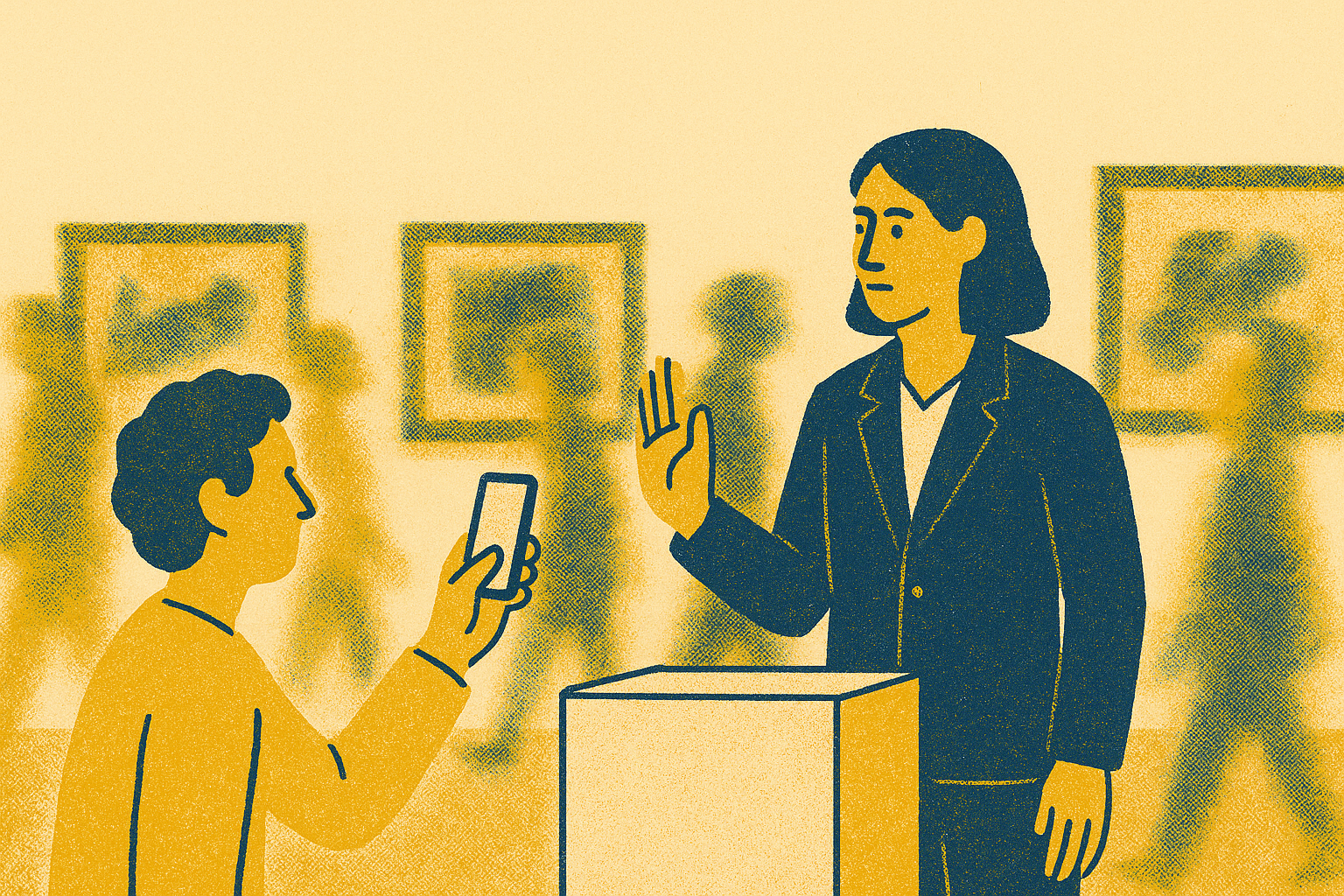
The first thing you notice at the Frieze stand of one of the larger London galleries this season is the small bowl. It is grey, the size of a sugar bowl, and it sits on the desk where the receptionist would normally hand out a price list. Phones go in the bowl. Phones come out at the door.
The dealers pretend it is for the artists. The artists, a few of them ringing each other on the train home, will admit it is for the dealers.
The art-fair photo pass was always a quiet bargain. Every visitor to the stand became, momentarily, a press agent for the gallery. A photo of a lit canvas turned up in someone else’s social feed within the hour. The gallery was paid in distribution; the visitor was paid in the small social currency of having been there. The bargain held for fifteen years.
What broke it is straightforward to describe and harder to admit. The same photo, in 2026, has another life the gallery did not consent to. It becomes a prompt. The lit canvas, properly cropped, properly labelled with the artist’s name, becomes input to a model whose training run will produce a thousand canvases that are not quite this one but rhyme with it. The gallery, which spent two years building the artist’s price ladder, has just been the unintentional research department for whatever generative tool processes the photo first.
This is not a hypothetical. Four of the larger galleries have publicly cited it as the reason for their phone-pass changes. A handful more have done the same thing without saying so.
The new policy is, at its surface, a disinhibition: please look at the work without the screen between you. The deeper move is economic. A canvas that has not been photographed cannot, easily, be the input to someone else’s model. The painter’s price ladder is, briefly, defended.
It is not a clean defence. Phones come back out at the door, and the museum across town has different rules, and the photograph of the photograph at the after-party makes its way to the same prompt regardless. But the friction matters. The gallery is buying a slower diffusion of the image, and slower diffusion is, in the current market, more valuable than wider distribution. The bargain has flipped.
Not every gallery is on the same side of this. A small, well-respected dealer in Bermondsey told a panel at Frieze that the no-phones rule was, in his read, a luxury position — that smaller galleries depend on the casual photograph the way bands once depended on the bootleg. He is right about the asymmetry, and the larger galleries should be honest about it. What works at a blue-chip stand does not necessarily work at a project space with three viewers a day. The phone, for some galleries, is still the only marketing budget.
The artists themselves have split as well. The painters, mostly, like the bowl. The artists who work in screen-native forms — moving image, data-driven sculpture, anything generative — find the bowl beside the point. Their work does not lose anything to a phone in the room. It already lives, in some form, on the screens the audience brought with them.
What is interesting is how the audience has received the change. Not, as the dealers feared, with offence. The phones-in-bowl ritual has become a small status signal — proof that the work in front of you is the kind that the gallery thinks worth protecting. The collectors do not seem to mind. The journalists do not seem to mind. The visitors who came to be photographed in front of the work have largely adapted, taking their photographs at the café across the road and tagging the gallery anyway.
A useful comparison: the early years of the Cinémathèque in Paris insisted that the film was the experience and that the print should not leave the room. That insistence cost the institution a certain kind of reach and bought it a certain kind of seriousness. The film became the thing you came to watch, not the thing you came to record. The current galleries are making the same trade. The work becomes the thing you came to look at, not the thing you came to forward.
The integrative point: the galleries are not refusing distribution. They are negotiating its shape. They are buying, very deliberately, a kind of friction the platforms have spent twenty years removing. The friction reads, to the audience present in the room, as care. Care, in 2026, is what scarcity used to be.
That is a strange sentence to type. It is also, looking at the bowl on the desk, increasingly true. Every gallery that figures out how to make care visible — without performance, without preachiness — is going to find an audience. Every gallery that does not is going to find its artists’ work inside someone else’s training run, faster than it can reprice the canvas.