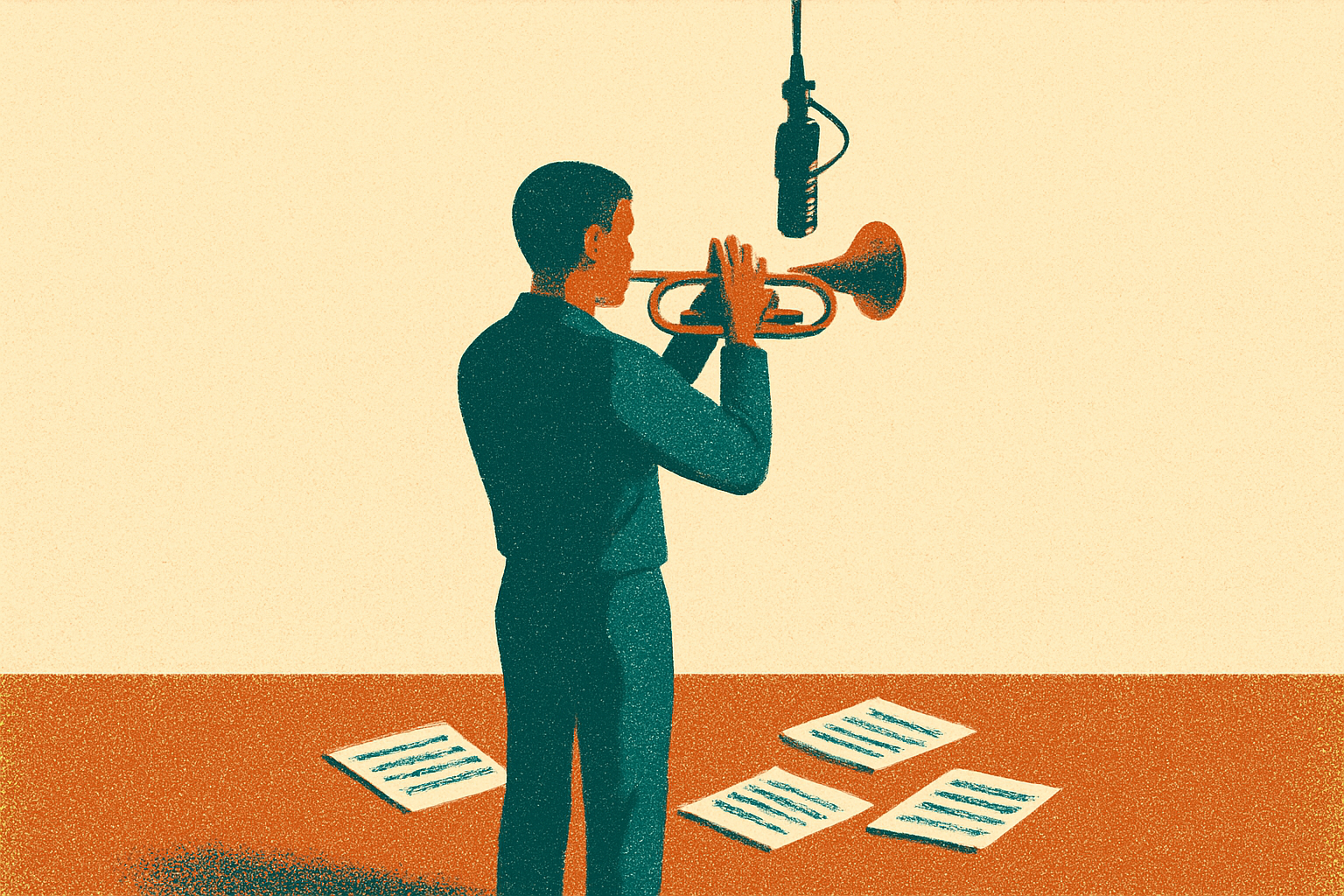
The horn line on the Kendrick deluxe, and the argument it makes against the algorithm.
Forty-two seconds of brass, slightly out of pocket, mixed in the middle distance. The deluxe edition as a quiet pivot toward the moments that did not survive the optimisation.
The horn line on the deluxe-edition track lands at 1:47 and stays for forty-two seconds. It is brassy, slightly out of pocket, and unmistakably from a player who knows the room he is playing in. The horn is the argument.
You have to listen for it. The track is dense — drums forward, vocal stacked, a synth pad doing most of the harmonic work — and the horn enters in the middle distance. Most listening, especially at the volume an algorithm-curated playlist will play at, will not catch it as a separate element. It will read as production texture.
That is the move. Not the horn itself, but the placement of the horn. The horn is not foregrounded because the horn is not, in this context, the point. The point is that the horn was played by a person, in a room, and the placement of the horn in the mix is a quiet declaration that on this record, in this moment, a person doing a thing is more interesting than a synthesiser doing the same thing.
This is a small position to take. It is also, in 2026, a position.
The deluxe edition, as a form, has been one of the casualties of generative tooling. The economics of cheap, fast extras have made the deluxe a place where labels stretch a record with material that did not earn its place on the original. Some of that material is, transparently, the output of production tools running at low cost. Some of it is genuinely surplus material. The deluxe has come to mean, for most listeners, the part you can skip.
Kendrick’s deluxe is not skippable. The horn line is one reason. The whole release is salted with these moments — a backing vocal that you can hear as a take, a guitar figure that drifts off the metronome and is left there, a piano chord that is held a beat past its natural exit. The choices accumulate. They argue for a record made by people, in rooms, with each other.
The album proper, by contrast, was not making this argument. The album proper was a tightly produced object, polished where polish was useful, and operating in the same sonic register as most of the rest of the chart. The deluxe is the artist’s quiet pivot: here is what we did when we were not trying to chart. Here are the moments that did not survive the optimisation. Here is the record before it was fitted to the room.
This is, in a way, an inversion of the deluxe tradition. The deluxe used to be the polished album with a few extras tacked on. This deluxe reads as the unpolished album with the polished one as its frame.
What is striking is that the discourse has caught on quickly. The streams on the deluxe have been disproportionate. Listeners are spending more time with the looser material than the polished. The reasons are not just sentimental. The looser material is, in 2026, more interesting because it is more identifiable — you can hear who is playing, you can hear what room they were in, you can hear that a person was paying attention to the take.
The horn line is the small, emblematic example. Forty-two seconds of brass played by someone with a reed and a mouthpiece in a room, recorded plainly, mixed lightly. That is, by the standards of the algorithm, an inefficient way to make a sound. It is also, by the standards of a listening human, an interesting way to make a sound.
The horn argues that interesting is winning. Not always, not yet, but in this record, in this moment, on the deluxe edition that was not supposed to do any cultural work and is doing more than the original.
A small note: the horn player is uncredited on streaming. The vinyl liner credits him properly. That, also, is the deluxe’s quiet position. The information is there, on the object, for whoever is paying attention. The platform’s metadata can catch up when it catches up.
The horn line lands at 1:47. The position lands somewhere later, the third or fourth time you play it through. Both are the record.