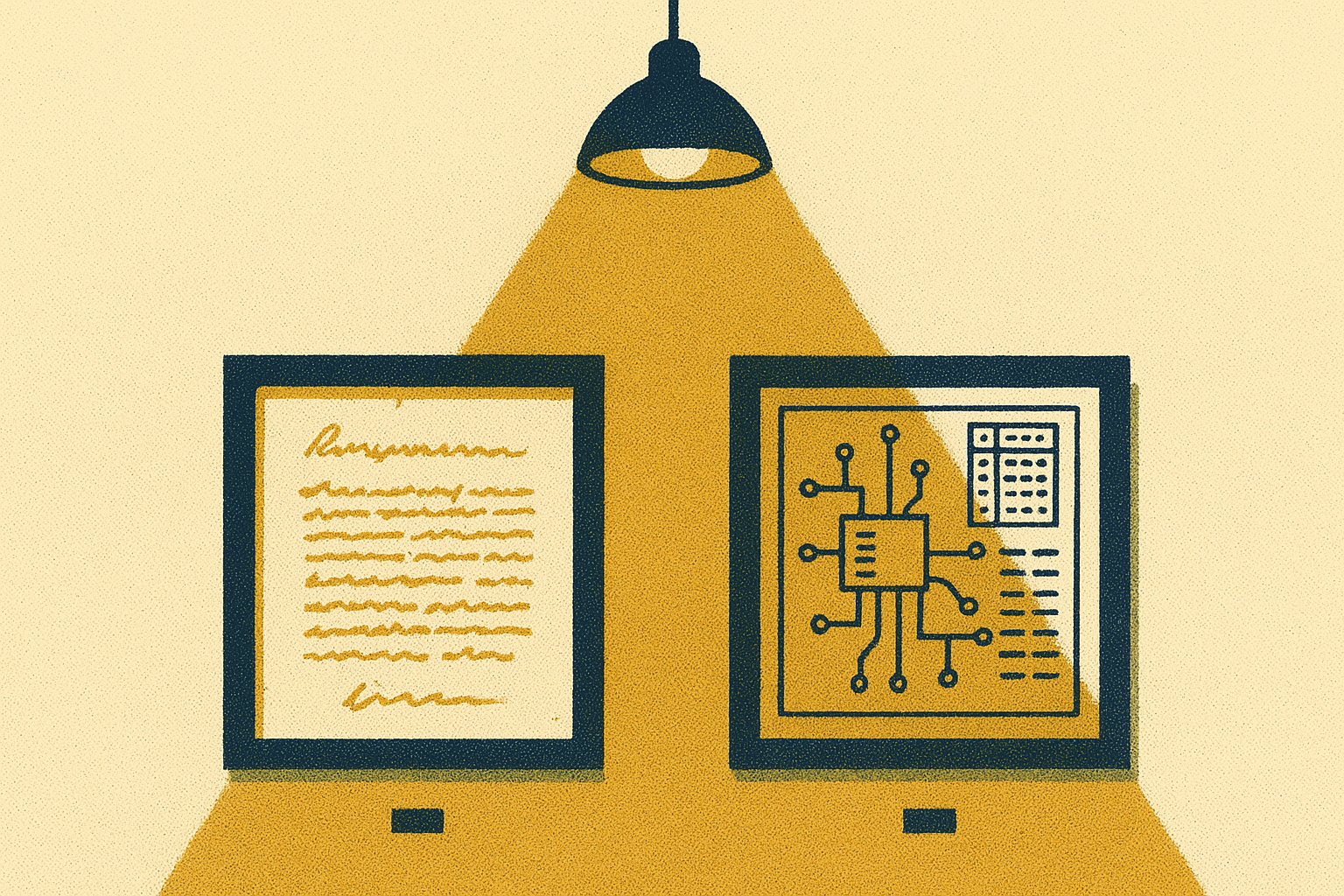
The statement and the card. What gallery copy looks like when the artist is a system.
The artist statement asks the viewer to trust the artist. The model card refuses to trust anyone. Both belong on the wall.
The artist statement is dying, and the model card is what is coming to take its place.
Walk through any commercial gallery in 2026 and you will find, increasingly, two pieces of paper next to a generative work. The first is the familiar one: a paragraph in a small serif type, in the artist’s voice, explaining what the work is about. The second is newer and has a different texture entirely. It lists the model used, the data sources cited as inputs, the version number, the inference parameters, the licence under which the model was distributed, and the carbon cost of the generation run. It is sometimes a single page. It is sometimes seven.
The galleries do not yet know what to do with the second piece of paper. Most of them tuck it behind the wall label or hand it over only on request. A few — the ones working with collectors who pay attention to provenance in the legal sense — hand it over with the receipt.
This is a small change in the room and a large change in the institution. The artist statement was always a bit of a fiction. It claimed an authorial voice that the work itself usually had to do most of the actual asserting. The model card is not a fiction. It is a compliance document. It records what was used to make the work in a way that a court, an insurer, or a buyer’s lawyer can pick over.
What is being lost, when the statement gives way to the card, is a particular kind of romance. The artist statement asked the viewer to trust the artist’s account of what the work meant. The model card refuses to trust anyone — it tells you what was used, and the meaning, if there is any, is the viewer’s problem.
A useful comparison: the wine label. Wine spent the better part of a century being marketed in the artist-statement register, with words like terroir and expression and vintage. In the last twenty years a different kind of label has taken over the bottles that move at scale: ABV, sulphite content, region of origin in legal terms, allergen information, calorie count. The romantic label still exists; it now sits beside the compliance label. The wine industry adapted by treating both as legitimate, each speaking to a different part of what the bottle is.
Galleries are about to discover the same arrangement is available to them. The artist statement does not have to die. It has to share the wall.
An incident from earlier this year illustrates the new register. A buyer at a London fair took a generative work home, hung it, and was contacted six weeks later by a lawyer working for a foundation whose archive had — without acknowledgement — been part of the model’s training set. The lawyer was not threatening. The lawyer was asking. The buyer, holding only the artist statement, had no idea what to say. The gallery, holding the model card, did. The card had named the data sources at the moment of sale, and the buyer was, in legal terms, downstream of disclosure. The transaction held.
The artists who are doing this best are the ones treating the model card as an honest document. They list every input, including the embarrassing ones. They publish the seed parameters. They are open about the hours of human curation that shaped the run. The collectors, in turn, are starting to pay a premium for the ones whose cards are clean — meaning the inputs are licensed, the model is provenanced, the labour is accounted for. Clean cards are the new clean provenance.
The artists who are doing this badly are the ones treating the model card as marketing copy — leaving fields blank, glossing the inputs, adding paragraphs of artist-statement language to a document whose value is in not having any. The collectors, who have seen this game played in other markets, can spot it.
The integrative read: the artist statement and the model card are both real, and both should be on the wall. The first speaks to what the work is for. The second speaks to what the work was made of. A gallery that handles only the first is operating on yesterday’s contract with its audience. A gallery that handles only the second is operating on tomorrow’s, and is going to find that the public, even the public that bought a generative work, still wants to be told what the work was about.
What the wall needs, in 2026, is both papers. One in a quiet serif, the other in a quiet sans. The audience reads both. Each does work the other cannot.
A small ritual: the gallery hands over both, folded together, to the collector at the close. The contract is in the second sheet. The reason is in the first. Neither, on its own, holds.