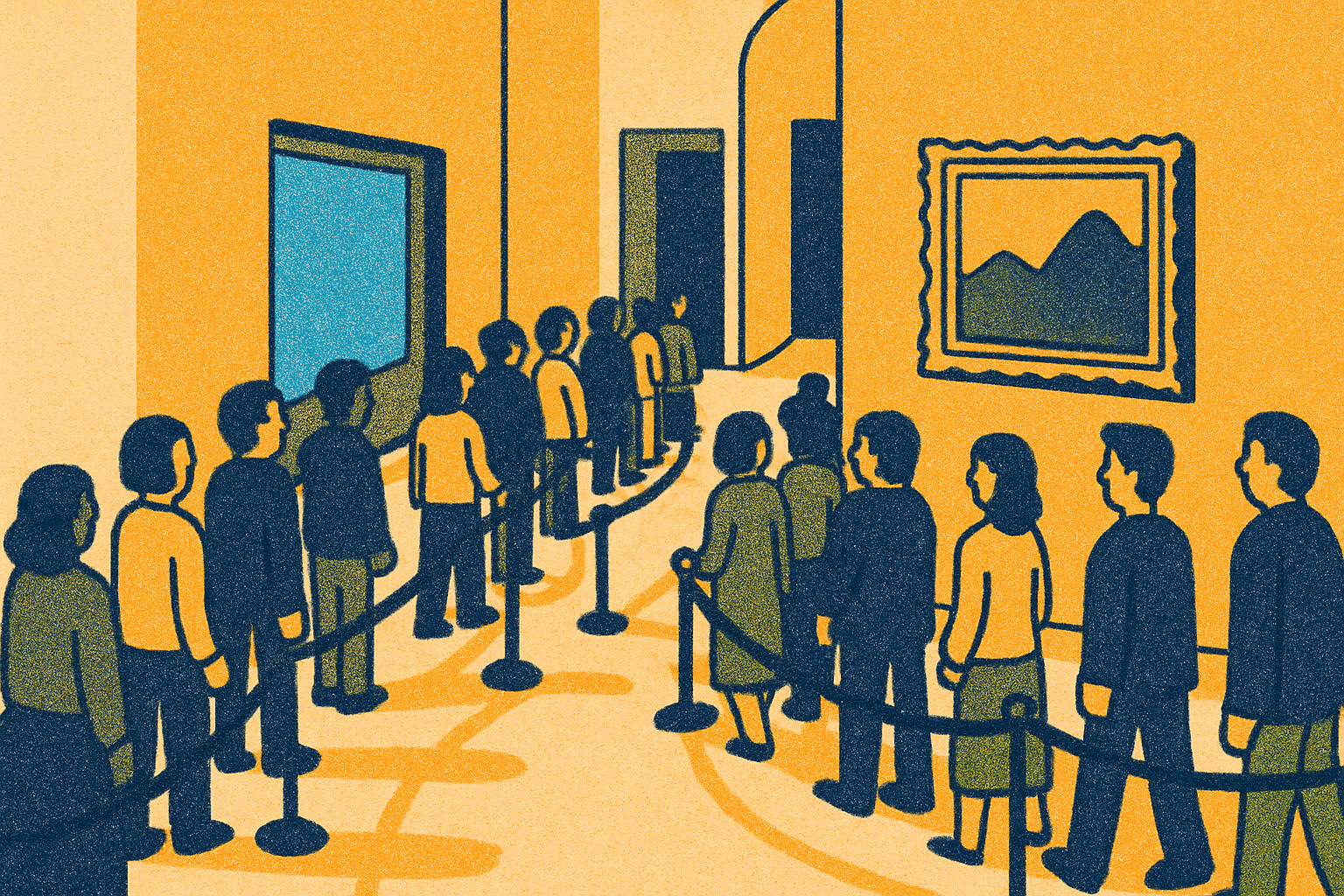
Two crowds, one building. The economics MoMA accidentally proved.
The Anadol queue and the Picasso queue share an admission ticket and almost nothing else. The institution funding both has not quite admitted which one is paying.
There are two crowds at MoMA right now, and they want different things from the same museum.
The first queues outside Anadol’s installation on the second floor. They are young, mostly. They have phones out before the gallery doors open. They are not there to think; they are there to be inside something. The work is generative — what the room shows at 11:14 a.m. on a Tuesday will not be what anyone else sees, and that is the point. The crowd treats the experience the way other crowds used to treat a concert: as an event to have been part of.
The second crowd is on the fourth floor, at the Picasso/Tanguy rotation. They move slowly. They read the labels. They take notes. The work has been there, in some form, for decades. The question they are asking — what does this mean, what was the artist doing — is the question museums were built to answer.
These two crowds have the same admission ticket and almost nothing else in common.
The institution that grew up around the second crowd had a clean economic model. Limited supply. Slow turnover. A wall label that did most of the interpretive work. The institution growing up inside the first one is a different beast. The supply is unlimited (the system can render forever). The turnover is fast (the audience keeps moving). The wall label gets in the way of the experience.
It would be easy to mark this as a generational story — the new audience for the new art — and many critics have. The simpler reading is economic. The Anadol crowd is buying access to a feeling. The Picasso crowd is buying access to a question. Both are paying the same museum.
The museum, for its part, is performing a balancing act it has not quite admitted to. The Anadol installation funds the upkeep on the building that holds the Picasso. The audience on the second floor pays for the audience on the fourth. This is not a critique. It is an observation about which crowd, in 2026, is producing the operating cash.
What is curious is how slowly the institution has acknowledged the trade. The press materials still frame the second-floor work as a programming experiment. The annual report still leads with the conservation initiatives on the fourth. The truth is that the experiment is now the engine.
A precedent worth holding here: photography. For a long stretch of the twentieth century, photography was the awkward second floor of the institution — popular, profitable, and never quite considered serious. The institution grew comfortable with photography only after it learned to charge a separate ticket and to write a different kind of label. The Anadol problem is not the photography problem repeated, but it rhymes. The institution is going to need a new label for the new crowd, and the label cannot just be a different version of the old one.
What the Anadol crowd is paying for is not the work in the way the institution understands work. It is paying for time inside a system that responds to it. The exhibit is closer to architecture than to image-making. The closest historical analogue is not photography. It is the chapel — a space you go inside, that surrounds you, that is sold on presence rather than ownership.
That comparison sounds grand and it is meant generously. Anadol himself is the first to say the work is not authored in the romantic sense; the model authors most of it, and his role is curatorial — choosing the data, shaping the frame, deciding when to stop. The crowd does not need him to be Michelangelo. They need him to have been the person who decided what they would feel.
The integrative point: the institution has not lost its old audience, and it has not betrayed its old mission. It has discovered, accidentally, that the new mission and the new audience are paying the bills. The hard work, now, is to write the new wall label honestly — without resentment, without nostalgia, without pretending the second-floor crowd is the fourth-floor crowd in a different shirt. They are not. They came for different reasons. The museum that figures out how to honour both crowds, in language and in the room, will be the museum that gets the next decade.
Everyone else will be running an Anadol exhibit and pretending the crowds outside are still there for the Picasso.