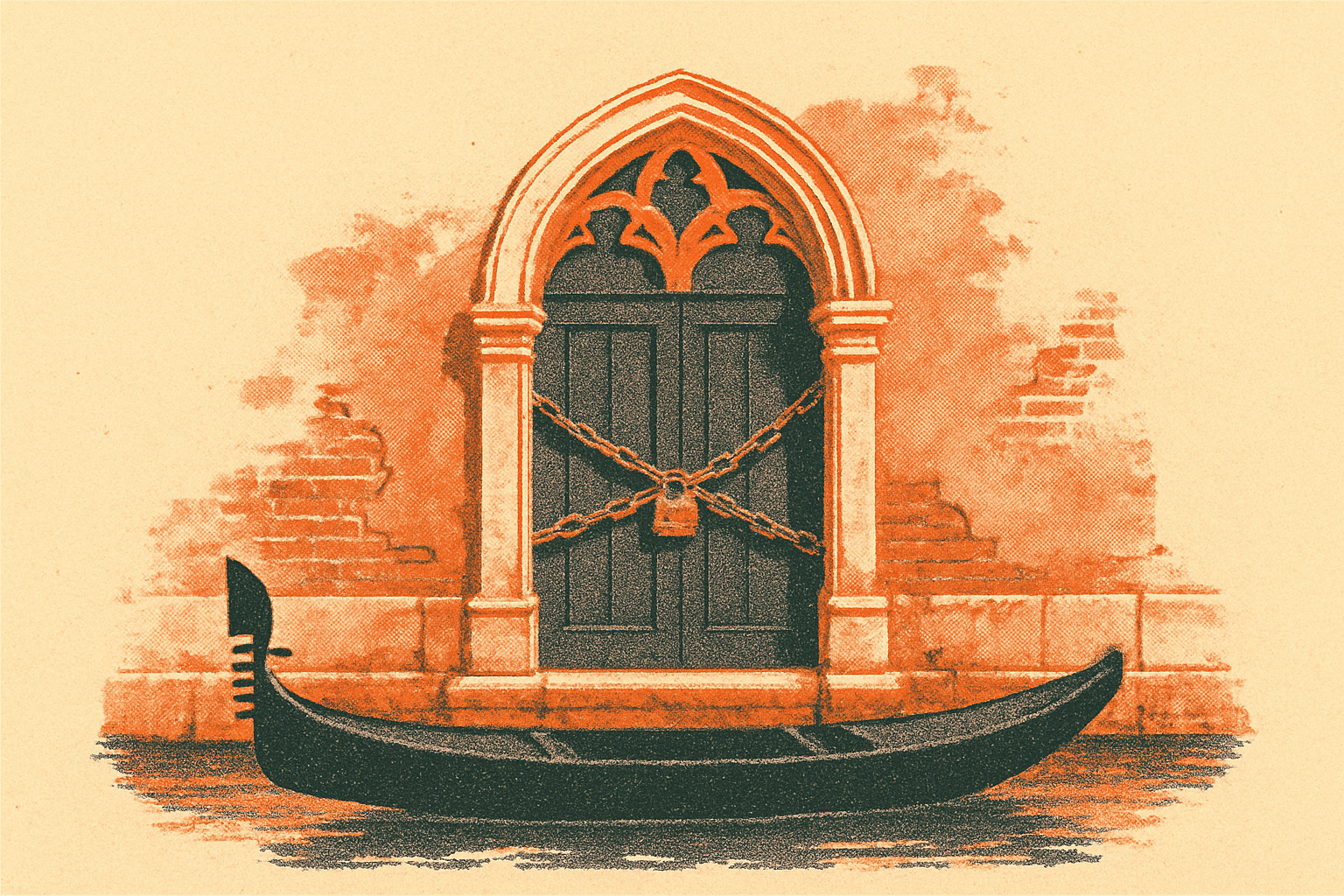
Venice stopped working. The Biennale didn't know what to do with that.
The May 8 strike shut down 27 pavilions, but the real fracture wasn't about Israel. It was about whether the oldest living art institution can still pretend politics happen elsewhere.
When thousands marched to the Arsenale on May 8 and found Italian riot police barricading Israel's relocated pavilion, the Venice Biennale had already lost control of its own opening week. Not to the protesters — to the question the protesters forced into visibility. What is the Biennale actually for, if not to be a platform where states present their best cultural selves while the military campaigns they fund continue offstage?
The 24-hour strike organized by the Art Not Genocide Alliance closed at least 27 national pavilions and pulled thousands into the streets. Artists from Austria to Turkey walked off. Some altered installations inside the main exhibition, adding Palestinian flags. The action targeted Israel's participation amid the Gaza conflict, but it also named something the Biennale has spent 131 years not naming: the event runs on precarious labor contracts and state sponsorships that come with geopolitical strings attached.
Nika Grabar, representing Slovenia in the Arsenale, told Artnet that "what this strike reflects is a deep structural crisis for the Biennale." She's right, but the crisis isn't new. It's that the crisis is now visible in a way the institution can't aestheticize or defer.
The easy framing is Israel versus Palestine, art versus politics, neutrality versus activism. The harder framing is that the Biennale has always been political — it was founded to assert Venice's cultural relevance after Italian unification cost the city its sovereignty — and what's changed is that artists are no longer willing to let the institution pretend otherwise. The five-person prize jury resigned days before the strike, announcing they would exclude artists from countries whose leaders face ICC warrants. That's not neutrality. That's a legal threshold imported into curatorial judgment, and it shattered the frame.
Mohammad Joha, a Gaza-born artist whose mother and sister were killed in Israeli airstrikes, told the crowd: "Art should not be a cover for genocide." That sentence does two things. It names what strikers believe is happening in Gaza. And it names what they believe the Biennale is doing by hosting Israel's pavilion — providing aesthetic legitimacy to a state engaged in what they see as mass atrocity.
The Biennale's defense has been consistent: we are an open institution. President Pietrangelo Buttafuoco has argued that excluding any nation would betray the event's founding principle. But the institution opened Russia's pavilion this year despite the invasion of Ukraine, despite an EU threat to withdraw two million euros in funding, despite 22 European culture ministers writing to say that "culture is not separate from the realities societies face." That principle, apparently, only runs in one direction.
There's a third frame here that neither the strikers nor the Biennale have fully articulated. The Biennale's structure — national pavilions, state sponsorships, diplomatic protocols — was designed for a world where cultural exchange between governments was understood as a good in itself. That world hasn't disappeared, but it's no longer the primary frame through which younger artists and workers understand their practice. They see labor precarity, funding from states committing what they view as atrocities, and an institutional apparatus that profits from both while styling itself as neutral ground.
The strike didn't resolve that contradiction. It made it impossible to ignore. Thousands showed up not because they thought one day of closed pavilions would change Israeli policy, but because working inside the Biennale's usual terms had become ethically uninhabitable. The Biennale responded by keeping the Israeli pavilion barricaded and releasing statements about openness. That's not a resolution. It's a stalemate dressed up as principle.
What happens next depends on whether the Biennale understands that its crisis isn't external. The protesters aren't disrupting the event. They're naming what the event has always been — a state-sponsored platform where culture and politics were never separate, only presented as if they were. The institution that survives this moment will be the one that stops pretending the distinction ever held.