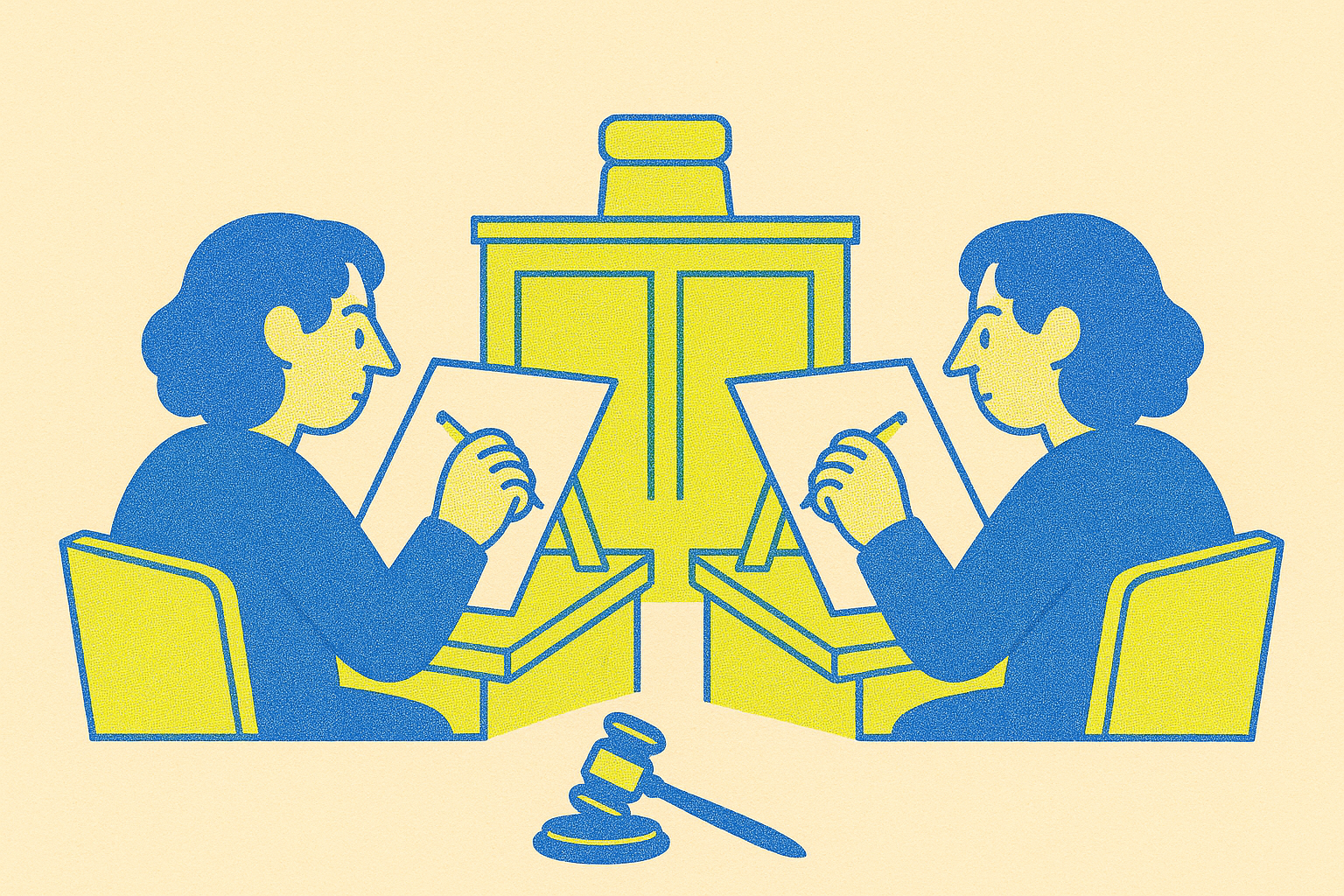
When two prompts meet in court. The first AI-vs-AI authorship case is a draftsman’s dispute.
Two generative artists, the same medium, a similar prompt, and a courtroom that is being asked to write a market’s rules in advance of the platforms doing it themselves.
The first AI-vs-AI authorship suit was filed in the Northern District of California earlier this month. Two generative artists, both using fine-tuned models, both selling on the same platform, both insisting the other infringed. The pleadings are dense. The actual fight is small.
What the suit is really arguing is whether one prompt can be similar enough to another to constitute copying — and whether the work that came out of either prompt is expressive enough to be infringed in the legal sense. The lawyers do not put it in those terms. They put it in terms of brushstroke equivalents and stylistic fingerprints. Underneath the language, the question is the question.
It is tempting to call this a courtroom novelty and move on. That would miss what is unusual here. For the first time, both parties are using the same medium. They are using the same family of models. They are making essentially the same kind of object — a high-resolution image generated from a textual instruction. The work product is comparable in a way two oil paintings are not.
What that comparability does to copyright is interesting. Copyright was built around the assumption that works diverge as authors diverge — different hands, different choices, different histories. Even close imitations carry the imitator’s body in them. Two generative works of a similar kind have less of the body and more of the prompt; the body of the artist is reduced to a small set of textual choices the model interprets.
The plaintiff’s argument leans into this. If the textual choices are the body of the artist, then close textual choices are close bodies, and close bodies infringe. The defendant’s argument leans the other way. If the textual choices are merely instructions and the model does the interpreting, then the model is the author, and a copyright claim against another instruction-giver fails for lack of human authorship at all.
Both arguments are cleaner on paper than they will play in court. The court will end up doing what courts do: looking at the work and deciding whether one feels too much like the other to be a coincidence. That is a reasonable move and it is the move the law has been making for a century. But it is also a move that will produce a strange precedent if it goes either way confidently.
If the plaintiff wins, the prompt is now copyrightable expression. That is a policy decision with consequences for every AI tool company in the country. If the defendant wins, the field becomes the wild west of close-cousin work. Neither outcome will feel right to all the parties paying attention.
A useful precedent: the early days of music sampling. When two records that sampled the same source sounded alike, courts had to decide whether the act of sampling produced enough new expression to count. They wobbled for ten years and eventually settled on a hybrid: sometimes yes, often no, depending on transformation. The AI-vs-AI case may have to wobble similarly. Some prompts are derivative, some are distinct, and the line between them is doing more work than a single ruling can carry.
The two artists themselves are not, by all accounts, bitter enemies. The platform that hosts them has been careful to take no public position. The audience that buys their work likes both of them and would be happy to see them resolve. The suit is being driven less by personal animus than by the platform’s own ambiguity — neither artist has been told, with any clarity, what their rights are on the surface they share.
That is the actual story. Not two artists fighting. Two artists trying to learn the rules of a market the market itself has not written.
The integrative read: the court is being asked to write the rules in advance of the platforms having decided what to do. That is awkward. Courts should not be the first place a market clarifies itself, and the platforms should not be silent while the lawyers do their work.
The honest path is for the platforms to publish — clearly, in plain language — what counts as derivative on their surfaces, and to do it before the court rules. They will not, because clarity is exposing. But they should. Until they do, every generative artist working at scale is one prompt away from a deposition, and that is not a healthy condition for an art market that wants to live in public.